McPherson County Dog Registration Information
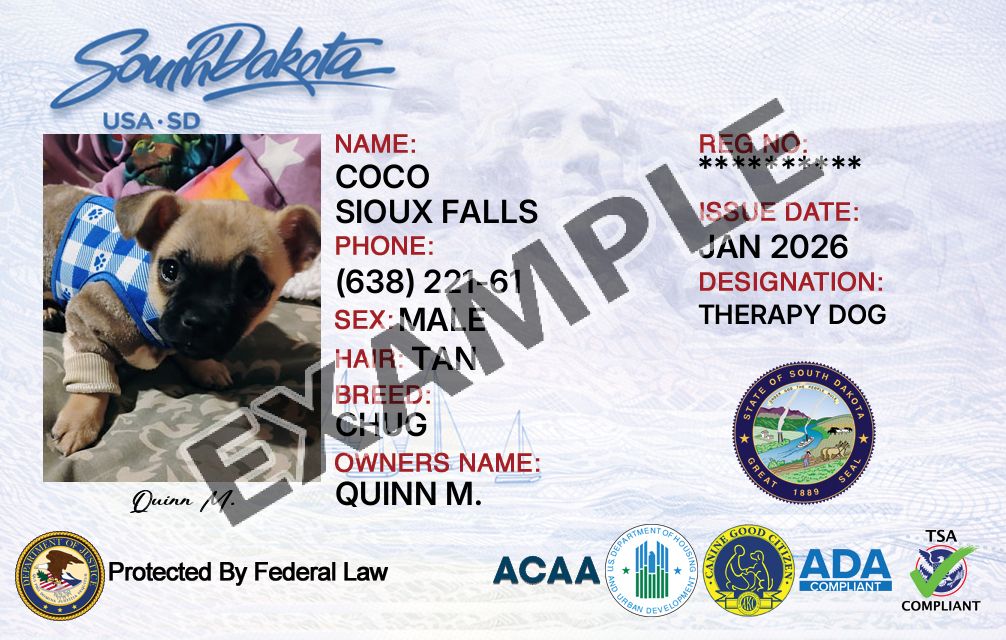
Service Dogs and Emotional Support Animals in McPherson, South Dakota
If you’re searching for where do I register my dog in McPherson County, South Dakota for my service dog or emotional support dog, the key thing to know is that a dog license in McPherson County, South Dakota is usually handled locally (often by a city office if you live inside city limits, and sometimes through county-level offices for county enforcement topics like rabies control). A service dog or emotional support animal (ESA) status is not created by a “registration” database—those legal categories come from disability law and housing rules, not from buying a license tag.
This page walks you through where to register a dog in McPherson County, South Dakota, what to bring (especially rabies vaccination proof), and how to understand the difference between local dog licensing, service dog legal status, and emotional support animal rules.
Where to Register or License Your Dog in McPherson County, South Dakota
Because dog licensing is often handled at the city level, start with the office for the town or city where you live (for example, Eureka). If you’re unsure which local authority handles licensing in your area—or you live outside city limits—county offices can help point you to the right place, and the Sheriff’s Office is commonly involved in enforcement topics (like running-at-large complaints) and coordination around animal-related public safety.
City of Eureka — City Hall / Finance Office
- Address: 705 8th St.
- City/State/ZIP: Eureka, SD 57437
- Phone: (605) 284-2441
- Email: eureka@valleytel.net
- Hours: Monday–Friday, 8:00 a.m.–4:00 p.m. (closed 12:30–1:30)
McPherson County Sheriff’s Office
- Courthouse Location: McPherson Co. Courthouse, 706 Main Street
- City/State/ZIP: Leola, SD 57456
- Phone: 605-439-3400
- Email: dave.ackerman@mcpherson.sdcounty.gov
- Hours: Monday–Friday, 8:00 a.m.–5:00 p.m.
McPherson County Treasurer
- Address: 706 Main St.
- City/State/ZIP: Leola, SD 57456
- Phone: (605) 439-3544
- Fax: (605) 439-3648
- Email: Not listed in the referenced source
- Hours: Not listed in the referenced source
McPherson County Auditor
- Address: 706 Main St
- City/State/ZIP: Leola, SD 57456
- Phone: (605) 439-3314
- Fax: (605) 439-3394
- Email: mcphersonaud@valleytel.net
- Hours: Not listed in the referenced source
McPherson County Clerk of Court (Fifth Judicial Circuit)
- Address: 706 Main Street (PO Box 248)
- City/State/ZIP: Leola, SD 57456-0248
- Phone: 605-439-3361
- Fax: 605-439-3297
- Email: McPhersonCoClerk@ujs.state.sd.us
- Hours: 8:00 a.m. to noon, Monday through Friday
Overview of Dog Licensing in McPherson County, South Dakota
What “registering your dog” usually means
In everyday terms, “registering your dog” usually means getting a local license (often a tag) required by a city ordinance or local rule. If you’re asking where do I register my dog in McPherson County, South Dakota, the most accurate answer is: start with your city office if you live inside city limits (for example, a city finance or city hall office), and if you live outside city limits, call a county office (often the Sheriff’s Office or courthouse administration) to confirm what applies in your township or rural area.
Why licensing is handled locally
South Dakota’s day-to-day dog licensing is commonly implemented through local government—cities and towns may set their own requirements for licensing, fees, tags, and enforcement. That’s why two residents in the same county can have different steps depending on whether they live inside a city boundary (like Eureka) or in the unincorporated county area.
Rabies rules: vaccination and enforcement
Rabies is addressed through state rabies-control laws and public health guidance, but vaccination requirements often show up in local rules and are widely required to obtain a license. Practically, you should expect to provide proof of current rabies vaccination when applying for a local license tag, and you may need to show it if your dog is involved in a bite or exposure incident. State agencies also publish rabies control information and reference the state rabies-control chapter.
How Dog Licensing Works Locally in McPherson County, South Dakota
Step-by-step: a typical local licensing process
- Identify your jurisdiction. If you live inside a city (for example, Eureka), contact that city office first. If you live outside city limits, call a county office to confirm where licensing is administered for your area.
- Gather required documents. Most offices will request rabies vaccination proof and basic owner identification details.
- Apply and pay the fee (if required). You may receive a license tag or proof of licensing.
- Renew when required. Some licenses are annual; others follow a different schedule depending on local ordinance.
Common reasons you may be asked to show licensing/rabies proof
- Dog running at large / impound situations
- Bite incidents or rabies exposure investigations
- Moving into a new city jurisdiction within the county
- Verification for rental housing pet policies (separate from service/ESA rules)
What to do if you can’t find a “dog licensing” page for your town
Smaller jurisdictions may not publish detailed online instructions. If you can’t quickly confirm where to register a dog in McPherson County, South Dakota, call:
- Your city hall/finance office (if you live in city limits)
- McPherson County Sheriff’s Office for enforcement guidance and the correct local contact
- McPherson County Auditor for county administrative direction to the right local authority
Service Dog Laws in McPherson County, South Dakota
Service dog vs. dog license: two different things
A service dog is defined by what the dog is trained to do for a person with a disability—not by a paid registration card or online certificate. A dog license in McPherson County, South Dakota, on the other hand, is a local government requirement tied to keeping a dog in a specific jurisdiction and is often connected to rabies vaccination and identification/tagging.
Public access basics (what businesses can ask)
Under federal ADA guidance, service animals are generally limited to dogs (with separate rules that can apply to miniature horses in certain cases). Staff at public places are typically limited to asking whether the dog is required because of a disability and what work/tasks the dog is trained to perform. They generally cannot demand documentation as “proof” of service dog status.
Local licensing still may apply
Even if your dog is a trained service dog, you may still need to follow local rules that apply to all dogs—such as leash/running-at-large rules and any local licensing/tag requirements—unless a specific local ordinance creates an exemption. If you want the most accurate answer for your address, call the city office where you live (or the Sheriff’s Office if you’re outside city limits) and ask:
- Whether your city requires a license tag for dogs kept in the city
- Whether service dogs have any fee or paperwork exemption locally
- What rabies vaccination proof is required to obtain a tag
Emotional Support Animal Rules in McPherson County, South Dakota
An ESA is not the same as a service dog
An emotional support animal provides comfort that helps with a disability, but an ESA is not a service animal for public-access purposes under the ADA. That means an ESA does not automatically have the right to enter places where pets are not allowed (like restaurants or grocery stores), even if it helps with anxiety or other conditions.
Where ESAs matter most: housing
ESAs are most commonly handled as a reasonable accommodation issue in housing settings. In many situations, a housing provider may need to consider an assistance animal request when it is connected to a disability-related need. This is separate from local licensing: you can be required to follow applicable local animal rules (like vaccinations and licensing) while also having housing-related rights for an assistance animal.
What local licensing means for ESAs
Having an ESA does not usually replace local requirements for rabies vaccination proof or local licensing where required. If your city requires it, you may still need a local dog license and may still need to show rabies vaccination proof to obtain the tag.
Frequently Asked Questions
Disclaimer
Licensing requirements and office locations may change. Residents should verify details with their local animal services office within McPherson County, South Dakota.
What You May Need
- rabies vaccination proof
- identification
- proof of residency
- licensing fee
Quick Clarity: License vs. Service Dog vs. ESA
Dog license
A local government requirement (often city-based) tied to residing with a dog in that jurisdiction—frequently connected to rabies vaccination proof and tags.
Service dog
A dog trained to perform specific tasks for a person with a disability. Not created by an online registration certificate.
Emotional support animal (ESA)
Generally relevant to housing accommodations; does not automatically grant public-access rights like a service dog.
Register A Dog In Other South Dakota Counties
Select your county below to get started with your dog’s ID card. Requirements and license designs may vary by county, so choose your location to see the correct options and complete your pup’s registration.
- Aurora County Dog Registration
- Beadle County Dog Registration
- Bennett County Dog Registration
- Bon Homme County Dog Registration
- Brookings County Dog Registration
- Brown County Dog Registration
- Brule County Dog Registration
- Buffalo County Dog Registration
- Butte County Dog Registration
- Campbell County Dog Registration
- Charles Mix County Dog Registration
- Clark County Dog Registration
- Clay County Dog Registration
- Codington County Dog Registration
- Corson County Dog Registration
- Custer County Dog Registration
- Davison County Dog Registration
- Day County Dog Registration
- Deuel County Dog Registration
- Dewey County Dog Registration
- Douglas County Dog Registration
- Edmunds County Dog Registration
- Fall River County Dog Registration
- Faulk County Dog Registration
- Grant County Dog Registration
- Gregory County Dog Registration
- Haakon County Dog Registration
- Hamlin County Dog Registration
- Hand County Dog Registration
- Hanson County Dog Registration
- Harding County Dog Registration
- Hughes County Dog Registration
- Hutchinson County Dog Registration
- Hyde County Dog Registration
- Jackson County Dog Registration
- Jerauld County Dog Registration
- Jones County Dog Registration
- Kingsbury County Dog Registration
- Lake County Dog Registration
- Lawrence County Dog Registration
- Lincoln County Dog Registration
- Lyman County Dog Registration
- Marshall County Dog Registration
- McCook County Dog Registration
- Meade County Dog Registration
- Mellette County Dog Registration
- Miner County Dog Registration
- Minnehaha County Dog Registration
- Moody County Dog Registration
- Oglala Lakota County Dog Registration
- Pennington County Dog Registration
- Perkins County Dog Registration
- Potter County Dog Registration
- Roberts County Dog Registration
- Sanborn County Dog Registration
- Spink County Dog Registration
- Stanley County Dog Registration
- Sully County Dog Registration
- Todd County Dog Registration
- Tripp County Dog Registration
- Turner County Dog Registration
- Union County Dog Registration
- Walworth County Dog Registration
- Yankton County Dog Registration
- Ziebach County Dog Registration